


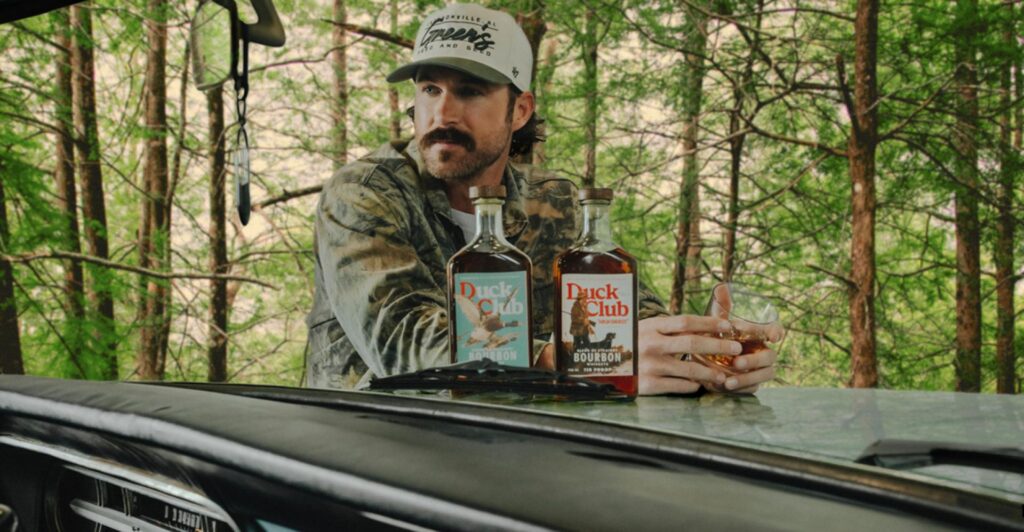
Riley Green’s rise in country music has been fueled by more than just hit songs. It comes from his ability to make listeners feel like they know him. From early standouts like “There Was This Girl” to fan favorites like “I Wish Grandpas Never Died,” along with chart-topping collaborations with Thomas Rhett and Ella Langley, Green has built his reputation on honest songwriting, a classic sensibility, and a deep connection to the roots that continue to shape him. Along the way, that approach has led to platinum success, major industry recognition, and a well-earned place among the genre’s most grounded voices.
What has always made Green stand out is the way he tells a story. His songs are packed with personality, memory, and lived-in detail, often drawing from the kinds of experiences that hit home with his audience. That same spirit is at the center of Duck Club Bourbon, a new venture that reflects not only his love of the outdoors, but also the traditions, values, and lifestyle that have long influenced his work.
Launched in partnership with spirits entrepreneur McCauley Williams and Morningside Brands, Duck Club Bourbon marks a new chapter for Green and the team behind it. Built on authenticity, heritage, and a genuine connection to the outdoors, the brand arrives with a distinct identity and a story of its own. Jason Price of Icon Vs. Icon recently caught up with Riley Green and McCauley Williams to discuss the vision behind Duck Club, the challenges of bringing it to life, and what makes the brand feel like such a natural fit.
You’re known for being a storyteller, and “Duck Club” feels like an extension of that in its own unique way, blending a bit of music and a bit of the spirits world. Taking it back a bit, what first drew you to the craft of storytelling?
Riley Green: My granddaddy, Beaufort, was a big country music fan. He loved Roy Acuff, Merle Haggard, and George Jones. He was also a really witty guy. He wrote poems, painted a little bit, and was just really good with words. Something about that drew me to country music. That was kind of what made a song country to me. I listened to all kinds of music growing up, but I just loved the stories and how hearing somebody’s story in a song could make you feel a certain kind of emotion. And I think whether I’d had any real success in country music or not, I still would’ve written songs, just because that’s something I’ve always really enjoyed.
The past decade has been a blur, and you’ve put in a lot of hard work along the way. How have you managed to stay grounded through it all?
Riley Green: Going home. I’ve still got my farm in Alabama, where I’m from, and I’ve always loved it down there. I’m a little bit of a homebody. I love the small-town lifestyle. After I signed my deal and moved to Nashville, I realized I didn’t have a whole lot in common with the big city, and I didn’t draw much inspiration from it either. So now more than ever, it’s important for me to go home because life just moves a lot slower down there. My buddies and family back there don’t treat me any differently than they did before, and I think that’s something you really need when you’re having that kind of success.
What drew you to the spirits world, and what made it something you wanted to invest your time and energy in?
Riley Green: That’s been something I’ve been interested in for a while, and I’d even gotten pretty far down the road in conversations with a few other brands along the way. I’ve always been a bourbon guy, and I was really just trying to find the right group, one that truly understood my brand, what I’m about, and the world I’m building. As soon as I sat down with the guys behind Duck Club, it was a no-brainer. The packaging, the label, and the story behind it all really caught my attention! It was something I didn’t feel like I needed to put my own touch on because it was already there. It fit so perfectly with everything I was doing.
Once that part was established, it really came down to trying the bourbon. I’ve got some pretty snooty bourbon friends who tend to turn their noses up at certain things, so you let them try it and see what they think. I got the thumbs-up from everybody involved, and that really excited me because it meant we had found something that actually works. That’s what’s so great about getting something right. And of course, having Morningside Brands behind it as well was a big part of that.


McCauley, you’ve played a huge role in bringing this endeavor to life. Can you tell us a little about your background and how this brand first came together?
McCauley Williams: I’m a spirits entrepreneur, is what I call myself. Under our Morningside portfolio, we have “Duck Club,” along with a tequila brand and a gin brand. Each one of them is deeply personal to me. The concept for this brand came from my experiences duck hunting with my father on the Tennessee River in Arkansas. We have an old hunting camp called White Oak on the river, dating back to the 1940s, and it’s filled with vintage hunting memorabilia. That really gave rise to the inspiration behind some of the mood boards and the initial label concepts we later showed Riley.
At its core, this brand is rooted in my childhood with my father and his friends. I learned early on that you grow up pretty fast at a duck club or duck camp because, after a couple of bourbons, all the old men tend to forget there are impressionable kids sitting there listening. You learn a lot about life in a hurry. And as a kid, you don’t really have speaking rights, so you just sit there and listen. Those experiences really shaped my childhood, and I’ve been an avid duck hunter ever since. At the core of the concept is the idea that whiskey is the official drink of duck hunting. Duck hunting happens in the winter, it’s cold, and it’s communal, unlike other forms of hunting. Deer hunting, for example, is more of a solitary sport, and a lot of other types of hunting are similar. Duck hunting is all about the camaraderie, the fellowship, and the lifestyle. A lot of times, you go out and don’t get any ducks, but you come back to camp or the clubhouse, pour some bourbon, sit by the fire, play cards, and tell stories. That lifestyle means a lot to me.
I was actually shocked, when I first started thinking through the concept, that there wasn’t already a brand out there really highlighting this way of life because it’s such an important part of who I am. The cool thing is that it’s not specific to just one region. Waterfowling and the entire culture around it stretch from Canada all the way down to Argentina. You also have all four flyways here in North America, each with its own unique subculture. We felt like it was this incredible Americana story and theme that hadn’t really been told from a liquor perspective, so it just made sense.
Once we got Riley involved, everything really started to click, and it’s been an amazing ride so far!
This is clearly more than a case of a celebrity simply putting his name or likeness on a bottle. It’s a true partnership. From your perspective, what does Riley bring to the table?
McCauley Williams: He’s the duck man, so that helped from the very beginning. Riley truly lives and embodies this lifestyle. You could put another celebrity on this brand, even somebody hugely famous, and it just wouldn’t work because it wouldn’t feel authentic. Riley talked earlier about storytelling, and to break out as an emerging liquor brand, we know we can’t outspend Diageo or Jack Daniel’s. We have to be craftier and more clever, and that starts with authenticity. It’s about pairing really high-quality juice with a genuinely authentic story and message. Riley is the epitome of that lifestyle on a national scale, and that’s a big reason why the brand has connected and been so successful so far.


Can you tell us a little about what went into bringing this product to life? I imagine it’s been an exciting ride for you and your team.
McCauley Williams: Yes, it definitely has been. This is my first real foray into the music world, or at least adjacent to it. I’ve launched several brands before this, and before getting into spirits, I was a mergers and acquisitions attorney. About 10 years ago, I entered the business by buying a defunct vodka distillery in Memphis and converting it into a whiskey distillery.
We never actually distilled. Instead, we focused on sourcing and blending, and that same concept has carried over into this brand. In today’s American whiskey market, there’s a huge surplus of aged barrel stock, so it would be silly to start distilling something new when there’s already so much quality supply available.
Instead, we work with some of the largest bourbon producers in Kentucky, sourcing unique batches, lots, and mash bills, then blending them together. We also have a great sourcing partner in Silent Spirits Group, led by Ryan Perry and master blender Sam Schmelzer, a 12-year veteran master blender at MGP. Ryan was the founder of “Heaven’s Door,” where he served as master blender, and I served as master blender for the brand I previously created, “Blue Note.” So the three of us, along with Riley’s input, source the barrels, blend unique batches, and really focus on quality.
I like to say that if you’re a craft distiller and feel the need to distill everything yourself, there can be a little bit of narcissism in thinking you can make something better than the greats. We don’t believe we can out-distill the greats, but we do believe we can identify the right barrels and out-blend through hard work and attention to detail.
What goes into defining the flavor profile early on, and at what point does Riley enter that process?
McCauley Williams: We put together a number of initial directions we could take it in. Sam is a true, full-blown master blender, and I’m more of a master blender by night. It’s amazing what they can do when you give them enough sample material to work with and see the kinds of combinations they can create. At the start, we had several different directions we could explore in terms of flavor profile, whether that meant something rye-forward, wheat-forward, spicier, sweeter, or more subtle. We sent some initial blends to Riley and his team, and from there we got feedback on the direction they responded to most, which really centered on approachability, and that really goes back to the authenticity of the lifestyle.
In bourbon today, especially during COVID at the height of the collector craze, there was this obsession with comparing collections and chasing rare bottles. In a lot of ways, that took bourbon away from what it’s really meant to be. Bourbon is supposed to be an everyman’s drink, something meant to be enjoyed by everyone. That’s the approach we’ve taken with our blends. Our 92-proof expression is a four-grain blend, combining a wheated mash bill with a rye mash bill. It’s bottled at 92 proof, non-chill filtered, and designed to be a super approachable, high-quality bourbon that even a novice can enjoy. That means it’s not the kind of bourbon that someone who doesn’t normally drink bourbon is going to taste and dislike, but it’s also one that a true connoisseur can respect.
We take that a step further with our 110-proof expression, which we call “High Brass.” With that one, the goal is really to overdeliver on quality and make sure it can stand up to the scrutiny of connoisseurs, journalists, and writers, while still being approachable enough for a newer drinker or someone who maybe only enjoys a couple of bourbons a year.

Riley, tell us a little about this experience from your point of view. How does it compare to what you’ve done creatively in the past?
Riley Green: The honest answer is, it’s a lot like writing a song with somebody you’ve never met before. Sometimes that can be a struggle. They may be a really talented songwriter, but they just don’t fully get what I do. Then it becomes a lot of back and forth, and I have to be really hands-on. Maybe they’ll throw out a line and I’ll think, ‘That’s a good line, but it’s just not right for me.’ Those kinds of days can get long. This wasn’t like that at all. This felt more like sitting down with a buddy where you’re both already coming from the same place and working from the same idea.
Everything they sent me, I was really excited about. You know what I mean? I also bounced a lot of the tastings off some of my bourbon buddies because I’m the same way with songs. When I write something, I can be too close to it. So I’ll play it for friends of mine who are real music guys and get their take.
The feeling McCauley talked about, that sense of, ‘I can’t believe there wasn’t already a brand telling this story and living in this space for duck hunters,’ I relate to that completely. I feel the same way about song ideas. We’ll sit down and say, ‘Man, how has nobody written this already? How did Brad Paisley not cut this 10 years ago? This should already be a song.’ That’s what this whole process felt like for me. It was awesome to work with guys who really understood the vision, the lifestyle, and my brand. Like I said, it makes things really easy when it comes together like that!
It goes without saying that you both have a lot on your plates. Looking back on bringing this to life, what were some of the biggest challenges you faced in getting this product off the ground, and how did you overcome them?
McCauley Williams: I’ll jump in and say the launch cadence, because with a new duck hunting-themed brand, we knew that if we didn’t get it out before duck season 2025-2026, which kicks off in most markets toward the end of November, we’d basically have to sit out an entire year.
For a spirits brand, it would be more traditional to launch in Q1 and build toward the following holiday season, since that’s typically the biggest sales window. But for us, that timing would have felt off for a duck brand to launch during turkey season. So, we had to push hard on the timing to make sure we hit the right window, because with ventures like this, everything always seems to take longer than you want it to.
We were operating under a really tight timeline, and I had to call in every favor I had with our distribution partners to launch in OND, which means October, November, and December. That’s the biggest sell-in season in the liquor business. There are only a handful of hard-and-fast rules in this industry, and one of the biggest is that you never, ever launch a brand in November or December. I had to call distributors I’ve worked with for the last 10 years and basically say, ‘All right, guys, I’m about to break the number one rule in our business. I need you to do this.’ [laughs] Then it was amazing! I thought it was going to be this huge obstacle, but once I presented the brand to them, they all said, ‘We get it, and we’re all in.’
Our whole team was blown away by the immediate buy-in from distributors, and even retailers who normally never take on new products came on board because they saw it, understood what we were building, and believed in it as well. I think that really goes back to the authenticity of the message and the storytelling behind the brand. There’s a saying that a picture is worth a thousand words, and I think our label, the bottle shape, and the packaging all tell the story right away. Our marketing team really knocked it out of the park because people instantly get it. That was definitely one of the biggest obstacles for me on the brand and distribution side of things.
Riley Green: Another obstacle for them was having to work around my schedule.
That’s understandable, especially since you’ve clearly been putting in the work at a pretty relentless pace.
McCauley Williams: Yeah! I don’t know how this guy does it, because he’s always on the move. He had a show last night and it looks like already in Louisville for a show tonight…
RG: Is that where I am? [laughs]
McCauley Williams: I honestly don’t know how he keeps up with it all. Just trying to follow it from afar on a calendar feels exhausting, so I can’t imagine what it’s like to actually live it and be the one at the center of it all.


Duck Club hits it out of the park with a gorgeous bottle and really striking artwork. It really captures the aesthetic of the duck hunting world. Can you give us some insight into your approach and how it all took shape?
McCauley Williams: I feel like that style of artwork, while there are still a lot of great artists out there, just isn’t as common as it used to be. One of the key insights behind the packaging was leaning into that retro feel, which ties directly back to my childhood with my father. My dad is turning 80 this year, and he was 43 when I was born, so there was definitely a generational gap there. A lot of my inspiration came from him. He never wore camo patterns when he hunted. He was very old school, more waxed canvas than modern gear, and that was the world I grew up in as a kid. At the time, I probably didn’t think it was very cool showing up with all that old-school gear, but now there’s such a strong sense of nostalgia around it.
There’s a real appreciation now for Americana and pop culture history, probably even more than there was when I was growing up in the ’90s and early 2000s. Because of that, we knew this brand could turn cheesy really fast if we didn’t get the design right. Once you start bringing hunting into the mix, it’s easy to go down that road. We’ve all seen hunting brands that just feel flat-out cheesy in the way they present themselves, and we knew we wanted to avoid that. We knew we wanted to go classic.
We handle all of our marketing and graphic design in-house at Morningside, and I sat down with our team and pretty much sketched out exactly what it needed to be. My dad and grandfather held onto every old issue of “Field & Stream,” “Outdoor Life,” and “Sports Afield” they could get their hands on, and we still have stacks of them at our family farm. Like Riley, I’m from a farm in Middle Tennessee, so that’s been something we’ve really bonded over.
All of that lived experience is really the genesis of the brand and where it all came from. We’ve actually lived this lifestyle. We’ve handled the vintage decoys, studied the old artwork, flipped through the old magazines, and absorbed that whole visual language firsthand. That’s what helped shape the style and bring it to life in a way that feels real.
You only recently launched, but you’ve already hit some big milestones. Looking back on bringing this to life, what’s been your biggest takeaway from the experience so far?
Riley Green: What are the key takeaways from bringing “Duck Club” to life? Well, like with any other business venture I’ve been involved in, it always comes down to the people you work with, the team around you, and everybody being aligned in their goals and vision.
That’s something I can’t take a whole lot of credit for, because what these guys brought to me from day one just felt easy. It was one of those moments where you think, ‘Oh, finally.’ I’ve had several brands and plenty of conversations with other people over the years, and I’ve gone pretty far down the road on a few of them, but it just wasn’t there.
When it’s right, you know it. You can see it. You can feel it working everywhere. The response has been great, and every comment I get about it feels like people are genuinely excited. That’s always a good sign, especially when you’ve got as many things going on in your career as I do. When something keeps generating that kind of consistent excitement, you know you’re onto something.
That’s outside of the music, and that’s what’s been so interesting about this. It’s kind of like my dog, Carl. People stopped asking what I was doing or what songs we were recording and started asking, ‘How’s your dog doing?’ You really start to see what people are connecting with. It’s the same thing at meet-and-greets. Those are the real fans, and you can tell what the hot topic is by what they bring up. “Duck Club Bourbon” has been one of the main things people keep asking me about. Again, I really appreciate it because I know it’s not always this easy, and it doesn’t always come together like this. So it’s cool to see something that really does seem to be working!
McCauley Williams: I haven’t told anybody in the media this yet, but this is shaping up to be one of the fastest bourbon launches ever. We’re not even six months old, and we’re already in 22 states and more than 2,500 liquor stores. We’re also on pace to put up some really significant numbers that I think the industry is going to take notice of.
Honestly, I keep having to pinch myself because I’ve brought a number of different brand concepts to life, and to echo what Riley said, sometimes it’s just really hard work because there’s a lack of product-market fit. At that point, you’re basically forcing something, and the market tells you that pretty quickly.
The market also tells you the opposite when there really is product-market fit, when there’s buy-in from the trade and buy-in from the consumer. It’s really fun to finally have a product that has that kind of fit.
So tell us a little about the future. I’ve seen in some earlier interviews that you’ve got a pretty exciting game plan in place.
McCauley Williams: We’ve got some new expressions in R&D right now, so keep an eye out for limited releases and some new offerings under the “Duck Club” brand. We also plan to keep expanding distribution, with the ultimate goal of going fully national.
And I’ll just say this, we’ve got some really exciting strategic partnerships with organizations in our lifestyle space that we’ll be announcing soon. I wish I could say more right now, but I can’t just yet. Those partnerships are really going to help bring this thing full circle, because again, authenticity is such a key part of what we’re trying to build.
With this having been such an exciting launch, how did you guys celebrate it, and what’s been the most memorable glass of Duck Club you’ve poured so far?
Riley Green: Since its debut, we’ve definitely celebrated at the bar! We’ve had several events at my place in Nashville called “The Duck Blind,” which is pretty fitting. And again, the timing of everything has been exciting. I think we opened that bar and, within a year, this was already something we were right in the middle of.
What’s really exciting, beyond the success the brand has already had, is that when something aligns this naturally, it becomes really easy to come up with ideas for promotion. Whether it’s doing something around duck season, which is something we all celebrate together, or putting on an event in Nashville, it’s easy for me to be part of because I don’t have to get on a plane to make it happen.
I find myself riding down the road just coming up with idea after idea for ways we can do something cool around “Duck Club,” how we can tie it into the shows, or create something backstage as part of the concert experience. I’m sure some of that is already in the works. I know we’re going to do some bottle signings and things like that.
How about you, MacCauley?
McCauley Williams: So, we launched this right before duck season kicked off with Riley’s “Duckman Jam” in Little Rock. Arkansas is one of the true meccas of duck hunting, so for our team, that made it even more meaningful. We announced the brand on Friday, Riley played the show on Saturday night, and when we got to our seats, he had a bottle with him onstage. We’d already shared a glass backstage, but then the camera zoomed in on the bottle and I almost fell out of my seat. It was just so surreal to see something we’d worked so hard on finally come together in that kind of moment. For the ops team and everyone involved, that was a huge milestone. Then getting to hang out backstage with Riley afterward was something we’ll never forget. What made it even cooler was that it all happened on opening day of duck season, so the timing really couldn’t have worked out more perfectly.

Riley, when can fans expect some new music from you, and how are you feeling about this next chapter? I know you’ve got a busy couple of months ahead.
Riley Green: You won’t have to wait long! I actually put out a song this morning called “My Way.” I’ve got a few more songs coming over the next couple of months, and right now we’re looking at putting a new record out in the fall.
Your songwriting has always stood out to me because there’s a real honesty and sense of place in it. How do you feel you’ve evolved as a songwriter since you first started out?
Riley Green: I think the biggest way I’ve evolved as a songwriter is really in my mindset. Early on, I looked at songwriting as something that was mostly luck. You just threw things out there and hoped something stuck. You see so many artists who have one hit, and that’s all you ever hear from them. Over time, I started looking at songwriting as something you can actually get better at. It’s a craft. If you write 30 songs, maybe one of them is going to be great, so you just keep hammering them out.
I’m also not too critical of the songs I wrote before I ever stepped foot in Nashville or had any real dreams of making a career out of this. Some of those songs are still around, and people still connect with them for some reason. At the end of the day, I think it comes down to saying things the way I would say them and never getting tired of writing about where I grew up and where I’m from, because that’s always been what’s worked for me.
You are real as they come, Riley. Thanks so much to both of you for taking the time to chat with me today, guys. As a fan, it’s been great to get a glimpse behind the curtain at what it took to bring this vision to life. The future looks very bright for Duck Club Bourbon, so keep the good stuff coming.
Riley Green: Thanks, Jason. I appreciate that!
McCauley Williams: Thank you, Jason!
To learn more about Duck Club Bourbon, visit the brand’s official website. For the latest on Riley Green, including music, merch, videos, and tour dates, head over to his official website. You can also learn more about McCauley Williams and the team behind the brand by visiting Morningside Brands.
With a clear point of view, a strong sense of identity, and plenty of momentum already behind it, Duck Club is poised to make a lasting impression in the spirits world!