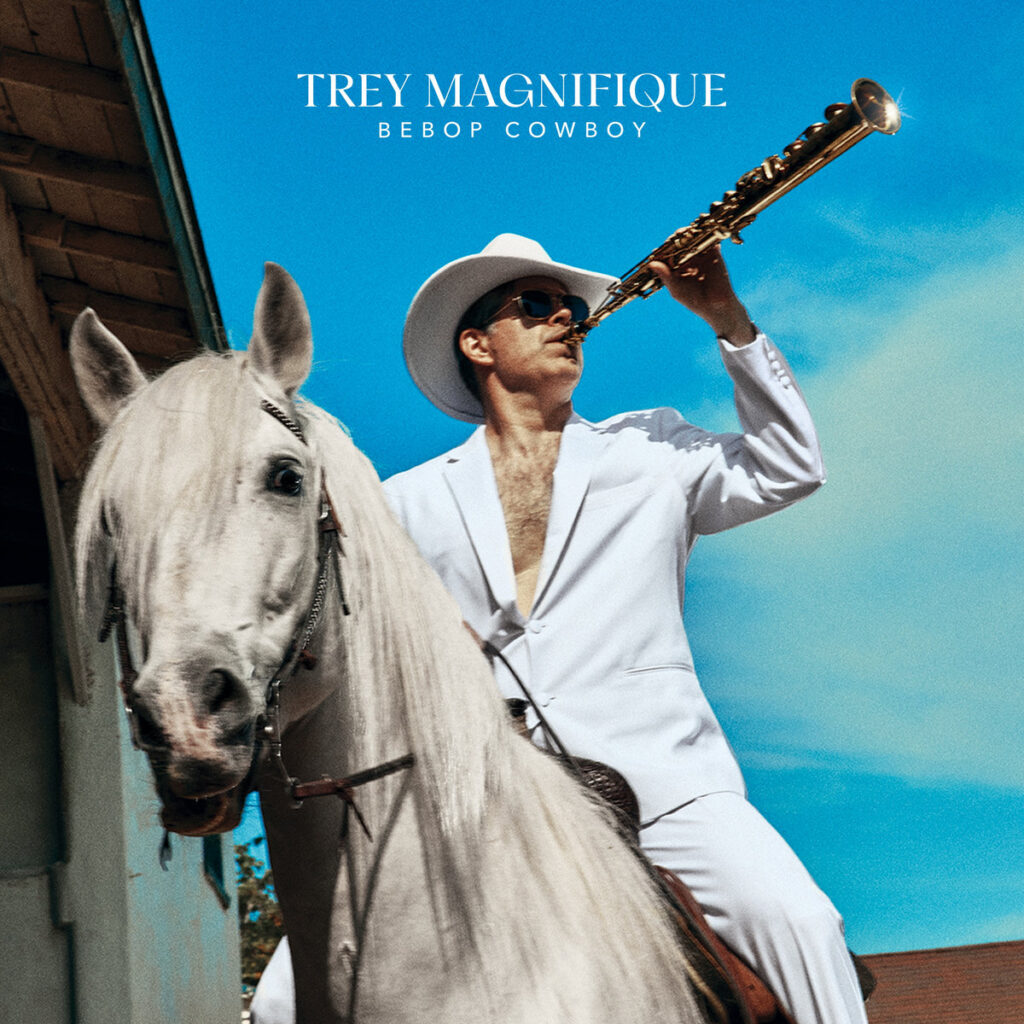
Three years ago Trey Magnifique burst onto the scene. The theoretical physicist turned comedy musician entered the jazz world with one of the smoothest albums in modern time, “Mature Situations”. Now, Mr. Magnifique dons a cowboy hat and spurs to give us “Bebop Cowboy”. Don’t let the name and persona fool you, this sax daddy hasn’t gone country western. The sultry sounds are as smooth as ever and we had the chance to catch up with the man to chat about the album and what he’s learned since his 2023 debut.
Back again with another Trey Magnifique record three years later. What have you learned in the past three years as you approached this new solo album?
Honestly, I think the biggest thing is that I’m a better sax player now than I was on the first album. Over the last three years, I’ve been performing a lot of Trey sets in front of live audiences both on tour and in my monthly show in Las Vegas at the Virgin Hotel and Casino. And just through the act of doing that over and over, I’ve become a better player, and also found the character’s voice. I’ve also figured out more about how comedy-forward I want the music to be, and I think we dialed back some of those aspects a bit on the second album. The project works better if my sax playing isn’t “funny”, and there were a couple of moments on the first album where in retrospect we went too broadly comedic.
As we revealed in our last chat, I am not a jazz aficionado. I love the music, but I’m a novice when it comes to deeper thinking about the genre. Can you explain the process when approaching a Trey Magnifique album? Are you sitting down with the purpose to write a song or do these songs spin out from “jam sessions” and the like?
A lot of the songwriting is just me at home messing around. My goal with this project is to write way more than makes it on the album, and there are a lot of songs that I start on that I never quite end up finishing because I’m just not that into them. And there are also full songs that we just don’t include. Obviously, a big part of the process is working with producer Commander Meouch, and his production is every bit as important to the voice of these albums as the actual songwriting, perhaps even more. Meouch has concrete ideas for how he wants some of these songs to sound and what gear we should be using, but we’re also trying things out in the studio and seeing what works.

While releasing this album you’re also in the middle of what I can say is a rare Starbomb tour! Hoping we get an extension of the tour with a closer date to me (in Maryland), but that’s off topic. You have so many outlets to unleash your creativity. Can you describe the difference when writing your smooth jazz album as Trey versus your writing process with Dan (and at times, Arin)?
It’s completely different, mainly because the other projects are comedy bands where the lyrics have to be funny. With Trey, the music has to speak for itself, and although I include one song with lyrics on each album, we play even those pretty straight. The comedy in Trey largely lives in the production, which makes it much more subtle. To me, the ideal Trey Magnifique song just works on its own even if you don’t get the joke, so we’re trying to do something very different than NSP or Starbomb, where if it’s not funny, the song is a failure.
Speaking of having many creative avenues musically, our last chat you described your journey from theoretical physicist to musician and eventually meeting Dan through improv. Is there a realm you haven’t had the chance to explore yet that you would like to?
I’ve been starting to do more vocals on stuff (like Starbomb and my kid band Go Banana Go), and I’d like to try to do more with that. The biggest challenge for me would be doing something that’s not comedy, but I don’t know if I’m brave enough to pull that off.

I know that your childhood household was filled with jazz due to your father. When writing music as Trey Magnifique are there any specific influences that you tend to channel?
This album has homages to Bruce Hornsby, Esquivel, Dave Brubeck, 90s Eurodance, 80s love duets, and more. It varies a lot song to song, but sometimes I’m trying to evoke a very specific composer or songwriter, and other times just a general vibe.
Who are a few of your other influences in both music and comedy?
For comedy music, Weird Al and Stan Freberg are my biggest influences. For music in general it’s kind of hard to specify individual people or bands since I listen to as much as I can, but my favorite composer is Duke Ellington, even though I don’t think you’ll hear much of his voice in my work.
You write music with Arin and Dan as Starbomb. Starbomb’s big focus is video game parody. Was gaming a big part of your life growing up? Is it still a part of your life now? How often are you truly the “Brian Pitches Ideas” guy?
I played classic NES console and PC adventure games a lot growing up, and I do play video games when I can now. I’ll usually do 2 or 3 big titles a year, with maybe a few others thrown in for variety. For Starbomb, generally we all talk about ideas, but it’s Arin who always has the most specific stuff, and then he and Dan go off and write lyrics on their own.
In our last conversation, you left us with these pieces of advice: “Just make the stuff you want to hear” and “Say yes to things. Take a chance on stuff because you never know where things are going to lead.” Things have led you from education to music and beyond. What would you say is the thing you’re most proud of when it comes to your accomplishments?
Just that I’m still getting to make the stuff I want to make, and that I get to do this as a career. That’s a rare thing, and I’m grateful for it.
Follow the continuing adventures of Brian Wecht in all his magnificent forms!
Trey Magnifique: Instagram | Twitter | SoundCloud